There is something quietly revolutionary about choosing bamboo as the foundation of a home. In a world increasingly conscious of environmental cost, bamboo house design offers an answer that feels both ancient and urgently modern. Civilizations across Southeast Asia, South America, and South Asia have built with bamboo for thousands of years, and today architects and homeowners worldwide are rediscovering what those cultures always knew — bamboo is one of the most intelligent building materials available to us.
Why Bamboo Is More Than Just a Trend
People often make the mistake of treating bamboo as a novelty, something you choose because it looks interesting or because you want to make an environmental statement. But the material earns its place on practical grounds alone. Bamboo grows faster than virtually any other plant used in construction, reaching full maturity in three to five years compared to the decades hardwood trees require. Its tensile strength rivals that of steel in certain conditions, and it handles compression remarkably well, which is why bamboo house design holds up so impressively in earthquake-prone regions of the world. Communities in the Philippines, Colombia, and Indonesia have lived in bamboo structures for generations precisely because those structures perform under pressure.
Beyond strength, bamboo regulates interior temperature naturally. Walls and ceilings constructed from bamboo breathe in a way that concrete and brick simply cannot, allowing air to circulate and keeping rooms cooler during hot months without heavy reliance on air conditioning. For anyone building in a tropical or subtropical climate, this is not a minor advantage — it translates directly into lower energy bills and a more comfortable daily life.
Design Possibilities That Surprise Most People
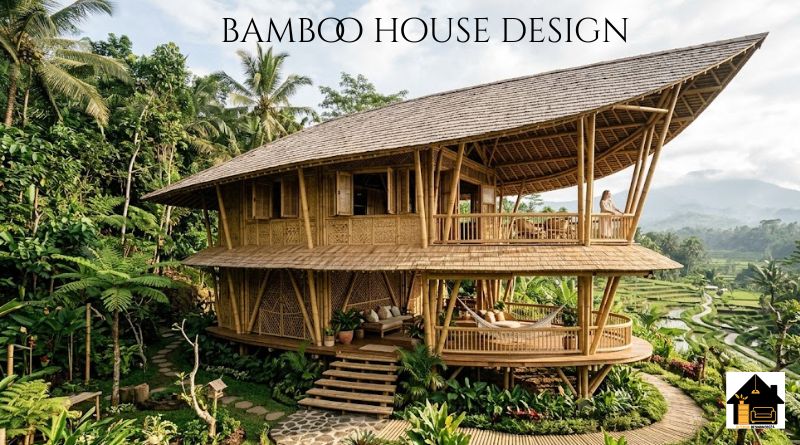
One of the most common misconceptions about bamboo house design is that it limits your aesthetic options. The opposite is true. Bamboo is extraordinarily flexible as a material, both literally and creatively. Architects can bend it into curved forms that would be expensive or impossible to achieve with conventional timber. It can be split into flat panels for flooring and wall cladding, laminated into structural beams, woven into screens that filter light beautifully, or left in its natural round form for an organic, sculptural quality.
Open-Plan Living With Natural Materials
Modern bamboo homes frequently embrace open-plan layouts that blur the boundary between interior and exterior space. Large sliding doors made from bamboo frames and glass panels open onto gardens, terraces, or surrounding forest, creating a living environment that feels genuinely connected to its landscape. The natural color palette of bamboo — warm golden yellows, soft greens, and deep browns — works effortlessly with stone floors, linen fabrics, and indoor plants, producing interiors that feel calm and grounded without being dull.
Structural Approaches Worth Knowing
There are two broad structural approaches in contemporary bamboo house design. The first uses whole bamboo culms — the full round poles — as columns and beams, lashed or bolted together in frameworks that are both visually dramatic and structurally sound. The second approach uses engineered bamboo products, including laminated bamboo lumber and compressed bamboo boards, which behave much like conventional timber and fit easily into standard construction workflows. Many projects combine both, using engineered bamboo where precision is needed and whole culm bamboo where visual character matters most.
Practical Considerations Before You Build
Choosing bamboo house design requires some honest preparation. Bamboo must be properly treated before use in construction — untreated bamboo is vulnerable to insects and moisture, which can compromise the structure over time. Treatment methods such as borax-borate solutions or traditional smoke-curing are effective and well-established, but they need to be part of the plan from the beginning. Working with a builder or architect who has genuine experience with bamboo is important for this reason. The material rewards knowledge and punishes shortcuts.
Maintenance is also worth understanding clearly. A well-built bamboo home with good roof overhangs, proper drainage, and periodic sealing of the bamboo surfaces can last for decades. The key is keeping the bamboo dry, because moisture is its primary enemy over the long term.
A Way of Building Worth Choosing
What draws people to bamboo house design ultimately goes beyond the practical. There is something deeply satisfying about living in a home made from a material that grew from the ground, that absorbed carbon as it grew, and that will return to the earth gracefully when its time is done. It is a way of building that asks you to think about your relationship with the natural world, and that almost always produces spaces of genuine warmth and beauty.